
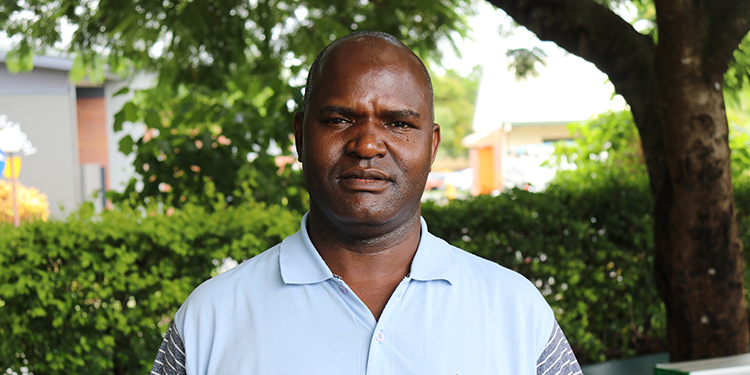
BEING the youngest of 11 children, Spiritan Father Edward Khaemba knows a thing or two about listening.
He says this is the best time to be in the Church because from the top down, from Pope Francis himself, the Church is trying to listen to everybody and everybody is being encouraged to listen to the Holy Spirit.
The best way to listen is to “remove stereotypes, remove judgments,” he says, and the best way to listen to the Holy Spirit is “don’t judge”.
“The Holy Spirit has been the same yesterday, as today and tomorrow – the same,” he says.
“So for me, I echo what Pope Francis is saying – it is not time for opinions, it’s time for listening.”
Fr Khaemba says he has learned that to be close to the Holy Spirit is to be close to other people too.
He saw that in the Spiritan priests who ministered in his parish where he grew up.
He was raised on a sugar farm in western Kenya, near Lake Victoria.
The sugar earned his parents enough money to send him and his siblings for quality education.
He remembers the long walks to school every morning, arriving before 7am because no one wanted to be in trouble for being late.
“I think, for us, it moulded us for other challenges ahead in the future,” he says.
He says being grateful to God, especially amid challenges, is important.
“Our parents did everything good for us,” he says.
“For me, I still remain grateful.
“I think for me the best prayer is just to be grateful.”
He’s grateful for the time he spent with his family.
“It was a nice just to look forward to Sunday, put on our best clothes and walk to church together,” he says.
His parents sent him to a minor seminary for his secondary education.
Of a class of 33, he was among the four students who decided to pursue priesthood.
“It was not a must,” he says.
“When I was there, the nuns were teaching us, the priests were teaching us and it is from their life and witness that I started to develop my vocation.”
There was no voice from the clouds or sudden epiphany that he wanted to be a priest.
Instead, he said with positive influences at school and in his home parish, he slowly developed a sense that priesthood might be for him and especially with the Spiritans, who were “so close to the people”.
It has been a continuous growth from there, he says.
“Even today, I continue to learn to be a better priest,” he says.
He spent time in his formation for priesthood in Australia, Uganda and Tanzania.
He remembers feeling homesick when he went overseas.
“It is an adventure – but adventure is a positive word and it also comes with a cost,” he says.
“For me, it was missing family, missing home.
“It is a sacrifice, but it is a good sacrifice.”
There was also a culture shock
Fr Khaemba loves the Church in Kenya.
He says it is a “very active” liturgy with everyone moving, dancing and lots of singing.
His time in Australia has shown him a different culture of faith and he has learned it is not good to compare because something like liturgy is a deeply personal and cultural expression.
He says it again highlights the importance of listening to others.
After his ordination in 2011, he was sent to Germany for his first post as a priest for four years before he was told there was a need for priests in Australia for Aboriginal ministry.
He arrived in Broome in 2015.
The local Aboriginal community called him, “holy one”, and he said they were the most generous people you could meet.
He said there was some hesitance to his arrival at first, but he made an effort to go out into the community – to go fishing with them, to go hunting.
“They don’t come to church, most of them, but they like you when you are participating in those small things like fishing, hunting, their gatherings,” he said.
“That’s how they want to meet their priests.”
Once trust was made it was a strong bond, he said.
He cannot remember a day that the Aboriginal community went fishing that they did not stop by and bring him some of the day’s catch.
Spiritually, he said, Aboriginal ministry taught him to always be ready to offer help immediately.
“Just be there and be available,” he said.
“If someone wants a sacrament, give it as soon as possible.”
Fr Khaemba cherished the trust that his flocks placed in him.
“People give us a lot of trust, people come and share with us; for me, it makes priesthood very special that people trust you immediately,” he said.
“They see you; they are open to you… and that comes with a responsibility.”
After Broome, Fr Khaemba went to Port Hedland in Geraldton diocese for six years before he was elected leader of his congregation in Australia and Papua New Guinea.
The challenge for his congregation at the moment is vocations.
Fr Khaemba says it is a struggle everywhere to get vocations.
He has noticed even in Catholic strongholds like Africa, he has seen less men pursuing priesthood.
“I always say the Church belongs to God, to Christ, and He will find a way– He will always find a way,” he said.
Fr Khaemba arrived in Bray Park parish in Brisbane’s north this month.
He says he has felt “very welcomed” by the community.
He sees lots of people staying back for fellowship after both Sunday morning Masses and says that it is a sign of a healthy parish.
There is also an abundance of volunteers, he says, and praised parish priest Fr Rogasian Msami for his work building up the community spirit.
Fr Khaemba will take over from Fr Msami as parish priest in July but until then, he says his priority is to get to know the locals and to listen.
By Joe Higgins – The Catholic leader